
About
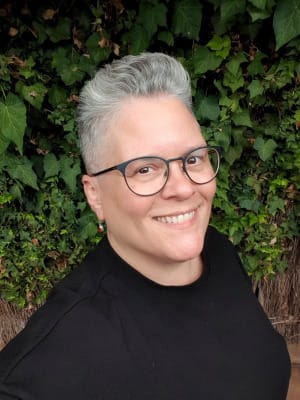
Liz Grandmaison is a PhD candidate at Adelaide University in South Australia. Her research centres on the GLAM sector - Galleries, Libraries, Archives & Museums - and what's needed to transform these institutions into the liberatory spaces they could be for workers and visitors alike. She is also a member of the South Australian Branch Committee of the Australian Museums and Galleries Association (AMaGA).
Before taking on her doctoral research, Liz worked as Program Officer at Flinders University Museum of Art and on the History Festival Team at the History Trust of South Australia.
Skills & expertise
- Skilled at communicating with clarity to audiences from diverse cultural and organisational backgrounds.
- Adept at converting complex information into accessible written and spoken content.
- Engaging and entertaining public speaker.
- Handy at wielding a camera, if you're into that sort of thing.
Publications
Bi-focals, beards and butches: queering history in museums
Nikki Sullivan, Craig Middleton, Liz Grandmaison & Millicent Wheeler (2022). 'Bi-focals, beards and butches: queering history in museums', History Australia, 19:3, 561-574
Abstract: Historically, museums have catered to and represented some individuals, groups and histories to the exclusion and detriment of others. In his critique of this tendency, Chris Taylor conceives museums ‘as instruments that intentionally shape cultural norms and values based on the dominant culture for society’. Like Taylor, many of those who are concerned by the exclusion of marginalised groups and histories advocate social inclusion as an ideal and a museological practice. Consequently, the last decade or so has seen the emergence of a number of temporary lesbian, gay, bisexual, transgender, queer plus (LGBTQ+) history exhibitions. At the same time, the active collecting of (what are perceived as) LGBTQ+ objects in order to tell LGTBQ+ histories has found its way onto the agenda of a growing number of museums. As we have argued in detail elsewhere, while such responses to past exclusions (and the material effects they produce) are not without value, they nevertheless all-too-often unintentionally reproduce the same logic that shaped exclusionary museological practices. In this article, we will elaborate what we see as the problematic epistemological underpinnings of social inclusion through the exploration of four assumptions that perpetuate heteronormative museological practice.
Not a shrine but a crucible: building the creative power of contestation into the museum
(Honours thesis, Flinders University 2020)
Abstract: How we see our history affects how we live in the now. As we experience global turmoil in the wake of the COVID-19 pandemic, economic distress and a crisis of representative democracy, we urgently need our museum sector to embark upon a new relationship with the public, one that welcomes knowledges and voices from outside the museum to help current and new audience members see history and the present from a multitude of perspectives. The conversation about how to activate and empower a larger, polyvocal audience takes place against the backdrop of a greatly contracted public sphere. Although audience development, marginalised voices and democratic crisis seem to present themselves as three disparate problems facing contemporary museums, I argue that the three are so intertwined that addressing them separately is counterproductive. To demonstrate how they might be addressed productively in tandem, I draw on insights from museum scholars and practitioners to argue that principles arising from critical pedagogies and radical democratic museum practice can be employed together to challenge dominant and marginalising narratives present in museums and their practices. When supplemented with elements from queer, feminist, anti-racist and post-colonial theories as required to suit institutional and community context, I argue that this framework has the potential to develop into a transformational force in museums’ efforts to enact positive social change.